At a glance, a delivery might look routine.
A truck arrives.
A load is picked up.
The journey begins.
It’s a process that repeats itself countless times each day—quietly, efficiently, and often unnoticed.
From the outside, it seems straightforward.
Schedules are followed.
Routes are planned.
Jobs are completed.
To most people, it’s just another task getting done as part of a busy day.
But not every load is what it seems.
Many loads look ordinary from the outside. Boxes, pallets, containers—it all blends in. At a glance, there is nothing that immediately stands out or suggests that the load requires any special attention. Everything appears consistent, controlled, and routine, much like any other delivery moving through the supply chain. There are no obvious warning signs, no clear indicators that anything is different, and no immediate reason to pause or question what is being transported.
But in transport, what you see is not always what you are dealing with. Behind those neatly stacked pallets or sealed containers, there can be materials that require a completely different level of awareness and handling. Some loads may contain items classified as dangerous goods—products that are widely used across industries but carry specific risks if not managed correctly. These goods do not always look hazardous, nor do they always come with clear visual cues that set them apart from standard freight.
This is what makes them easy to overlook. Because they are so commonly used and regularly transported, they can start to feel familiar. And when something feels familiar, it is often treated as low-risk. Processes become routine, checks may become less thorough, and assumptions can begin to replace careful verification. Over time, this can create a gap between what is assumed about a load and what is actually present.
That gap is where risk begins to build. A load that appears straightforward on the outside may require specific handling, storage conditions, or restraint methods to ensure it remains safe throughout the journey. Without a clear understanding of what is inside, decisions are often made based on appearance rather than reality. And in transport, even small misunderstandings can have larger consequences, particularly when the load involves materials that are sensitive to movement, pressure, or environmental changes.
It is not always the obvious hazards that cause problems. In many cases, it is the risks that are not immediately visible—the ones that blend in with everything else—that are most likely to be underestimated. And when those risks are not fully understood, they can easily be carried forward through the entire transport process, unnoticed until something goes wrong.
Some items may be classified as dangerous goods, meaning they have properties that can pose a risk to people, property, or the environment if they are not handled correctly. This includes materials such as flammable liquids, gases, chemicals, batteries, and even certain everyday products used in workplaces. While the term “dangerous goods” may sound like it only applies to highly specialised or unusual substances, many of these items are actually common across a wide range of industries.
These materials are used regularly in sectors such as construction, logistics, manufacturing, and maintenance, which means they are frequently stored, transported, and handled as part of normal operations. Because of this, they do not always stand out as something that requires extra attention. They are often packaged in standard containers, loaded alongside other goods, and moved through the same processes as general freight.
And that is where the challenge lies. Because they don’t always look different, they can be easy to overlook. Without a clear understanding of what they are and the risks they carry, they may not be handled with the level of care they require. This is what makes dangerous goods particularly important to recognise—not just because of what they are, but because of how easily they can blend in with everything else.
When something is clearly hazardous, people tend to be more careful.
They slow down.
They double-check.
They follow processes more closely.
But when a load appears standard, that awareness can fade.
It’s easy to assume everything is fine.
That’s where problems can start.
Because when dangerous goods are involved, the risks can escalate quickly:
What might have been a minor issue with a regular load can become far more serious.
When something is done often enough, it starts to feel routine. Tasks become familiar, processes become quicker, and decisions are made with less hesitation. Over time, what was once approached with care and attention can begin to feel automatic. And when something feels routine, it can also begin to feel low-risk. People rely on past experience, assume outcomes will be the same, and move through the process without stopping to reassess the situation. While this can improve efficiency, it can also reduce the level of attention given to each step. Important details may be overlooked, and checks that were once deliberate can become rushed or skipped altogether.
But risk doesn’t disappear just because something feels familiar. In fact, familiarity can create a false sense of confidence. When a task is repeated regularly without incident, it becomes easy to assume that nothing will go wrong. This kind of “it’s fine” thinking can quietly reduce awareness, making it less likely for potential issues to be noticed early. Small warning signs may be ignored, and assumptions may replace careful verification. Over time, this shift in mindset can increase risk, especially in situations where conditions can change or where the load itself may require more attention than it appears to. Maintaining awareness, even in routine tasks, is essential to ensuring that familiarity does not lead to complacency.
Understanding what is actually being transported is one of the most important steps in reducing risk. It goes beyond simply recognising the type of load at a surface level and requires a clearer awareness of what the materials are, how they are classified, and what risks they may carry. Without this understanding, decisions are often based on assumptions rather than accurate information. This can affect how the load is handled, how it is secured, and how potential risks are managed throughout the journey. When there is a lack of awareness at the beginning, it can carry through every stage of the transport process, increasing the likelihood of something being missed or overlooked.
For those looking to build that understanding, a dangerous goods course can provide a practical foundation. It helps clarify how goods are classified, what risks they carry, and how they should be handled in real-world situations. Rather than relying on guesswork or past experience alone, training provides a structured way to approach transport safety. It allows individuals to better recognise when a load may require additional care and to apply the appropriate precautions from the outset. Over time, this knowledge supports more informed decision-making and helps create a more consistent approach to managing risk across different types of loads.
Load restraint is often thought of as simply “making sure nothing falls off.” While that idea captures part of its purpose, it doesn’t fully reflect the role it plays in transport safety. Proper load restraint is about maintaining stability throughout the entire journey, not just preventing items from leaving the vehicle. It involves understanding how a load is positioned, how weight is distributed, and how different restraint methods work together to keep everything secure. When done correctly, it helps protect the driver, the vehicle, and other road users by reducing the likelihood of movement that could lead to loss of control or unexpected hazards. It also plays a role in minimising damage to goods and ensuring that loads arrive in the same condition they were sent.
This is where skills related to securing cargo and safely loading and unloading goods become especially important. Knowing how to secure cargo properly means understanding not just the equipment being used, but also how different types of loads behave under movement, braking, and cornering. At the same time, the way goods are loaded and unloaded directly influences how stable that load will be once the journey begins. A poorly loaded vehicle can create risks before it even leaves the site, while a well-planned approach to loading, restraint, and unloading helps create a more controlled and predictable transport process from start to finish.
Every movement on the road—braking, turning, accelerating—affects the load. These actions create forces that act on the cargo, even when they seem minor from the driver’s perspective. A sudden stop can shift weight forward, a turn can cause sideways movement, and acceleration can push the load backward. Over time, repeated movements can gradually loosen or destabilise items that were not properly secured to begin with. This is why load restraint cannot rely on appearance alone; a load that looks stable when stationary may behave very differently once the vehicle is in motion. Understanding how these forces interact with different types of loads is essential to ensuring that restraint methods are suitable for real-world conditions, not just ideal ones.
This is where structured approaches like the Safe Load Program come in. In real-world transport, conditions are rarely consistent. Roads can be uneven, traffic can be unpredictable, and situations can change quickly without warning. Relying solely on experience or routine is not always enough to manage these variables effectively. A structured approach provides a more consistent way to assess loads, identify potential risks, and apply appropriate restraint methods before the journey begins. It helps ensure that decisions are based on understanding rather than assumption, allowing individuals to respond more effectively to the conditions they may encounter on the road.
The goal isn’t just to meet requirements—it’s to ensure safety in practice. While compliance sets a baseline, real-world safety depends on how well that knowledge is applied in everyday situations. A load may meet minimum standards, but if it has not been secured with real conditions in mind, risks can still arise during transport. Structured programs help bridge this gap by focusing not only on what needs to be done, but how and why it should be done. This deeper understanding supports better decision-making and encourages a more proactive approach to managing load safety, rather than reacting to issues after they occur.
When dangerous goods are involved, there is less room for error. These types of materials often have properties that make them more sensitive to movement, pressure, temperature changes, or impact. What might be considered a minor issue for a general load—such as slight shifting or inadequate restraint—can carry greater consequences when dangerous goods are present. This means that the level of attention, planning, and care required needs to be higher from the very beginning. Assumptions that may seem harmless in other situations can quickly become risks, particularly when the nature of the load is not fully understood.
The impact of an issue involving dangerous goods can extend well beyond damaged freight. While loss or damage to goods is one concern, the potential effects can also include risks to people, harm to the environment, and disruption to operations. In some cases, a single incident can affect multiple parties, from those directly involved in the transport process to others sharing the road or surrounding area. This broader impact is what makes awareness and proper handling so important. It shifts the focus from simply completing a delivery to ensuring that the process is carried out safely and responsibly at every stage.
Incidents rarely happen because of one major mistake. More often, they develop gradually through a series of smaller decisions that, on their own, may not seem significant. Each step in the process can feel manageable, especially when time pressures or routine tasks are involved. A quick assumption here, a missed check there—these moments can seem harmless in isolation. However, when they occur repeatedly or in combination, they begin to change the overall level of risk. What starts as a small oversight can quietly build into a larger issue, particularly when there is no clear pause to reassess the situation.
Small decisions can build into larger issues over time, creating a chain reaction that is not always immediately obvious. For example, rushing a loading process may lead to something being overlooked, which can affect how the load is secured. That, in turn, can lead to movement during transport, increasing the likelihood of instability or damage. Each step connects to the next, and once the process is in motion, it can be difficult to correct. This is why attention to detail at every stage is important. Even minor actions contribute to the overall outcome, and when those actions are not carefully considered, the risk can continue to grow without being noticed until it becomes a problem.
Every load is shaped before the truck even moves. Long before the vehicle is on the road, decisions are already being made that influence how safe that journey will be. From how goods are packed and stored, to how they are labelled and prepared for transport, each step plays a role in determining the condition of the load. These early stages often happen behind the scenes, but they are critical in setting the foundation for safe transport. If something is overlooked at this point—whether it’s incorrect packaging, missing information, or poor load preparation—it can carry through the entire process and become much harder to correct later on.
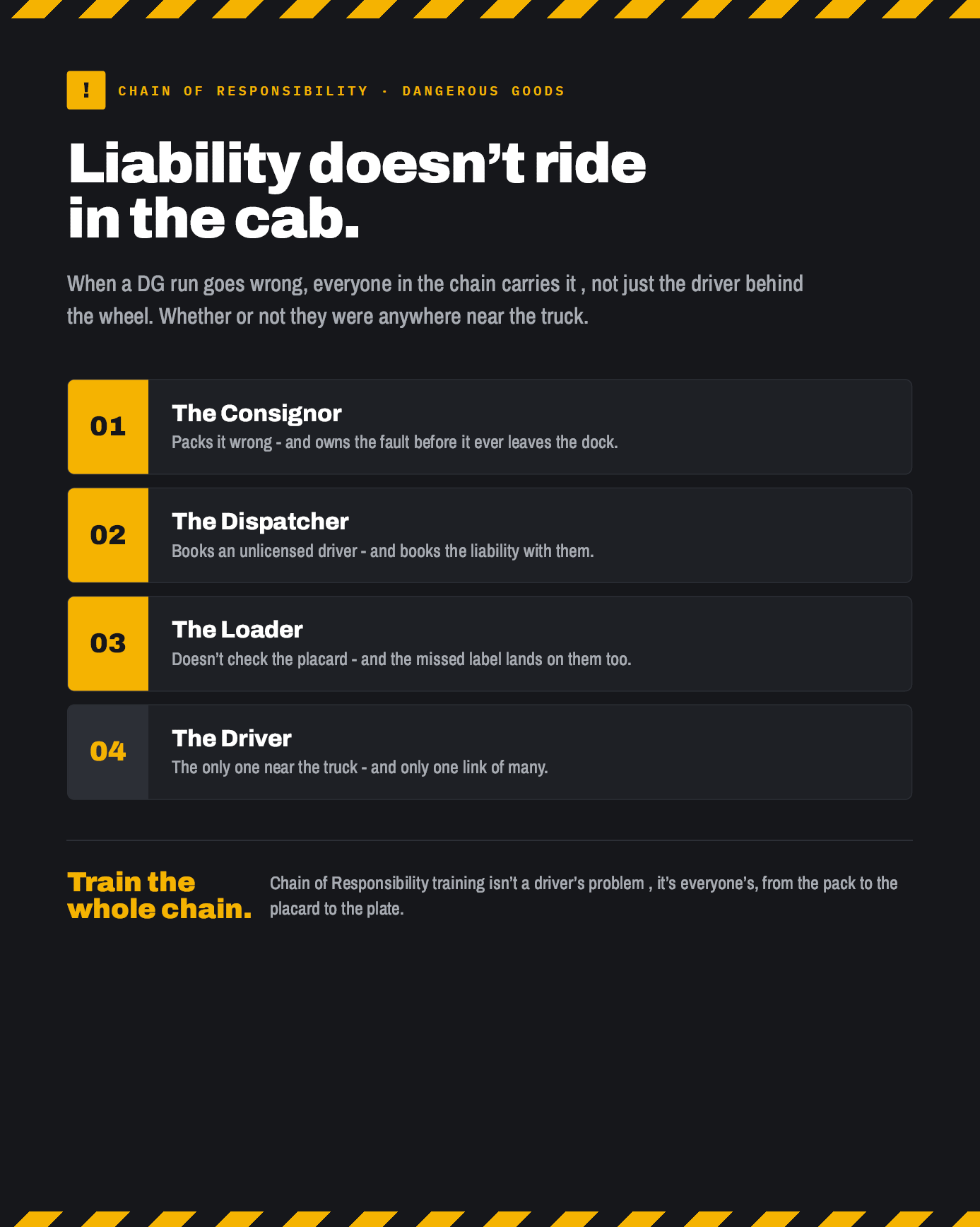
Multiple people contribute to the safety of the load, and each role carries its own level of responsibility. Those preparing the goods, loading the vehicle, planning the job, and overseeing operations all play a part in ensuring that the load is handled correctly. Safety is not dependent on a single person, but on how well each part of the process works together. When communication is clear and each step is carried out with care, the overall risk is reduced. However, when gaps appear—whether through assumptions, rushed decisions, or lack of awareness—they can affect the entire chain. Recognising that responsibility is shared helps create a more consistent and proactive approach to transport safety.
Creating a safer transport environment doesn’t always require complex systems or major changes. In many cases, it starts with awareness—taking a moment to pause and think about the situation before moving forward. This can be as simple as asking a few key questions that help shift the focus from assumption to understanding:
These questions may seem basic, but they play an important role in how decisions are made. They encourage a closer look at the load rather than relying on appearance alone. They help identify whether additional precautions may be needed and whether the load has been properly assessed before the journey begins. By asking these questions early, potential risks can be recognised before they develop into larger issues.
Awareness leads to better decisions, and even small shifts in thinking can have a meaningful impact over time. When individuals take the time to question what they are doing and why they are doing it, they are more likely to notice details that might otherwise be missed. This doesn’t slow the process down significantly, but it adds a level of consideration that supports safer outcomes.
Over time, these small habits can become part of everyday practice. Instead of reacting to problems after they occur, awareness allows risks to be managed proactively. It creates a more consistent approach to safety, where decisions are guided by understanding rather than routine. And in transport, where conditions can change quickly and risks are not always visible, that awareness can make a significant difference.
Next time you see a truck on the road, it’s easy to think of it as just another delivery. It becomes part of the background—something familiar that happens every day without much thought. From the outside, it looks simple. A vehicle moving from one place to another, carrying goods as part of a routine process. But what we see on the surface rarely reflects everything that’s happening behind the scenes. Every load has been prepared, handled, and transported through a series of decisions that most people never notice. And within those decisions, there may be risks, considerations, and responsibilities that are not immediately visible.
Because it’s not just a load. It’s what’s inside it—and how it’s handled—that makes all the difference. The way a load is understood, secured, and managed plays a key role in determining how safely it reaches its destination. When that understanding is clear and the right precautions are taken, risks can be reduced before the journey even begins. Safer transport doesn’t start on the road—it starts with awareness, preparation, and the decisions made along the way. And often, it’s those decisions, made long before the vehicle moves, that have the greatest impact on the outcome.